Process and Mechanical Engineering Essentials
Course Location:
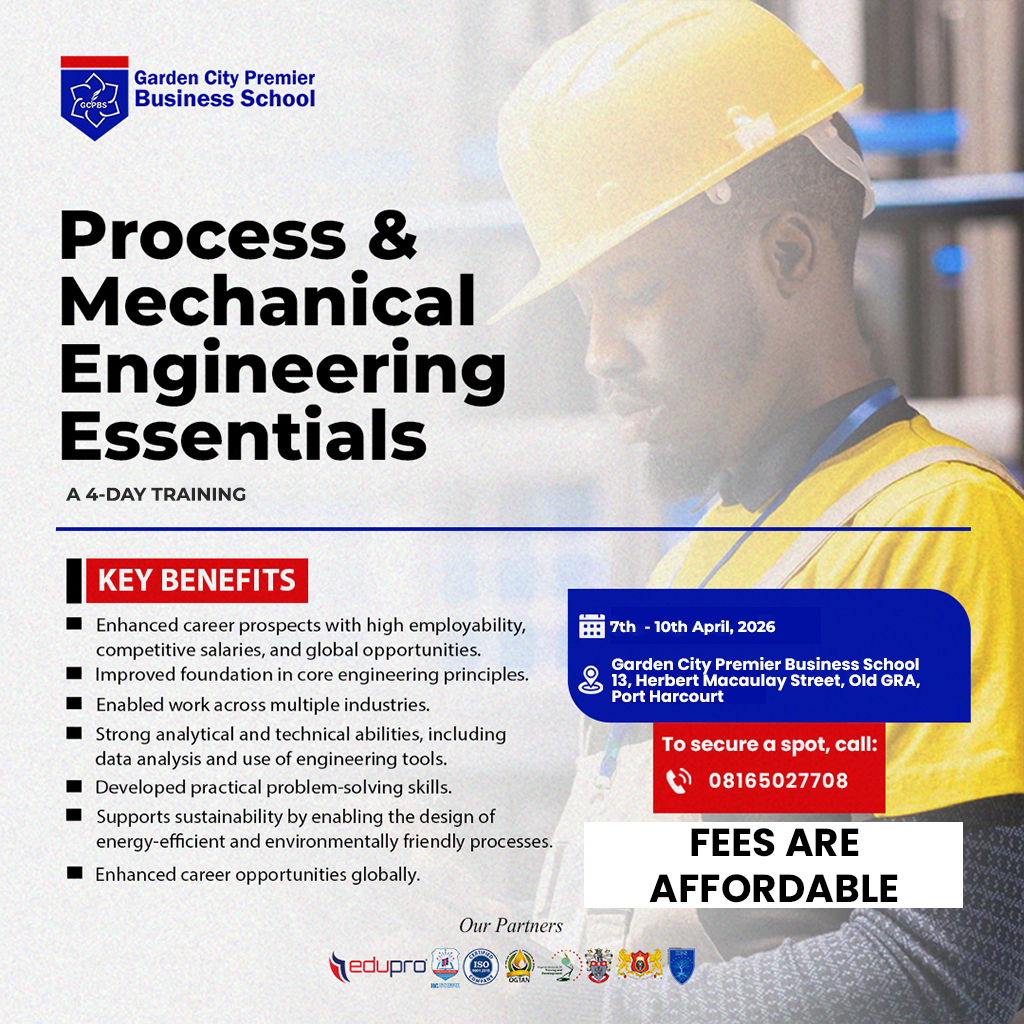
Garden City Premier Business School, No. 13 Herbert Macaulay Street, Old GRA, Port Harcourt
WEEK ONE
DAY 1: Introduction & Fundamentals of Process Engineering
Introduction
This session lays the foundation for process engineering by introducing core principles that govern industrial operations. Participants will gain a deep understanding of how mass and energy flows are analyzed and controlled within systems, alongside exposure to reactor configurations and safety considerations. The focus is on building analytical thinking and practical interpretation skills essential for engineering design and plant operations.
Objectives
- Understand fundamental principles of process engineering systems
- Apply mass and energy balance concepts to real industrial processes
- Interpret process flow diagrams (PFDs) effectively
- Identify safety risks including flammability limits and hazard zones
- Analyze different reactor types and their industrial applications
- Understand piping & instrumentation diagrams (P&IDs)
- Develop basic risk assessment and hazard analysis skills
Course Outline
Morning Session:
- Principles of process engineering
- Mass and energy balances
- Process flow diagrams (PFDs)
- Safety and flammability considerations
Afternoon Session:
- Types of reactors
- Reactor selection criteria
- Piping & instrumentation diagrams (P&IDs)
- Risk assessment and hazard identification
DAY 2: Heat Transfer & Reaction Engineering
Introduction
This session explores the mechanisms of heat transfer and their critical role in industrial efficiency. It also introduces reaction engineering principles, focusing on how chemical reactions are controlled and optimized for productivity, sustainability, and cost-effectiveness.
Objectives
- Understand modes of heat transfer (conduction, convection, radiation)
- Calculate heat transfer coefficients
- Identify and size heat exchangers appropriately
- Analyze chemical reaction kinetics
- Understand catalytic processes and their industrial relevance
- Apply green chemistry principles for sustainable engineering
Course Outline
Morning Session:
- Heat transfer mechanisms
- Heat transfer coefficients
- Heat exchanger types and sizing
Afternoon Session:
- Reaction engineering principles
- Catalysis and kinetics
- Green chemistry and sustainability
DAY 3: Process Control & Economics
Introduction
This day integrates engineering control systems with economic decision-making. Participants will learn how to monitor and regulate industrial processes while evaluating their financial viability, ensuring optimal performance and profitability.
Objectives
- Understand different control systems used in process industries
- Identify key process parameters for monitoring and control
- Apply feedback control principles
- Evaluate economic feasibility of engineering designs
- Conduct break-even analysis
- Estimate equipment and plant costs
Course Outline
Morning Session:
- Types of control systems
- Process monitoring parameters
- Feedback control systems
Afternoon Session:
- Economic analysis fundamentals
- Fixed vs variable costs
- Break-even analysis
- Equipment cost estimation
DAY 4: Materials Selection, Types & Failures
Introduction
This session focuses on material science and its application in engineering design. It emphasizes selecting appropriate materials based on performance requirements while understanding failure mechanisms to ensure safety and durability.
Objectives
- Understand engineering material properties and performance criteria
- Select appropriate materials for specific applications
- Analyze material strength and durability
- Understand non-destructive testing methods
- Identify different types of metals and materials
- Evaluate failure mechanisms and prevention strategies
Course Outline
Morning Session:
- Material properties and selection
- Load-bearing capacity
- Non-destructive examination
- Energy absorption and fracture
Afternoon Session:
- Material testing methods
- Types of metals
- Failure mechanisms
- Engineering standards and codes
DAY 5: Rotating & Static Equipment / Structural Integrity
Introduction
The final day provides practical insight into industrial equipment used in process systems. It covers rotating machinery and corrosion management, emphasizing reliability, maintenance, and long-term asset integrity.
Objectives
- Understand types and operations of pumps and compressors
- Interpret pump and compressor performance curves
- Select appropriate equipment for industrial applications
- Understand corrosion mechanisms and risks
- Apply corrosion prevention and protection techniques
- Implement inspection and monitoring strategies
Course Outline
Morning Session:
- Pump types (positive displacement & dynamic)
- Pump curves and selection
- Compressor types and performance
Afternoon Session:
- Corrosion fundamentals
- Types of corrosion
- Inspection and monitoring
- Corrosion prevention techniques