
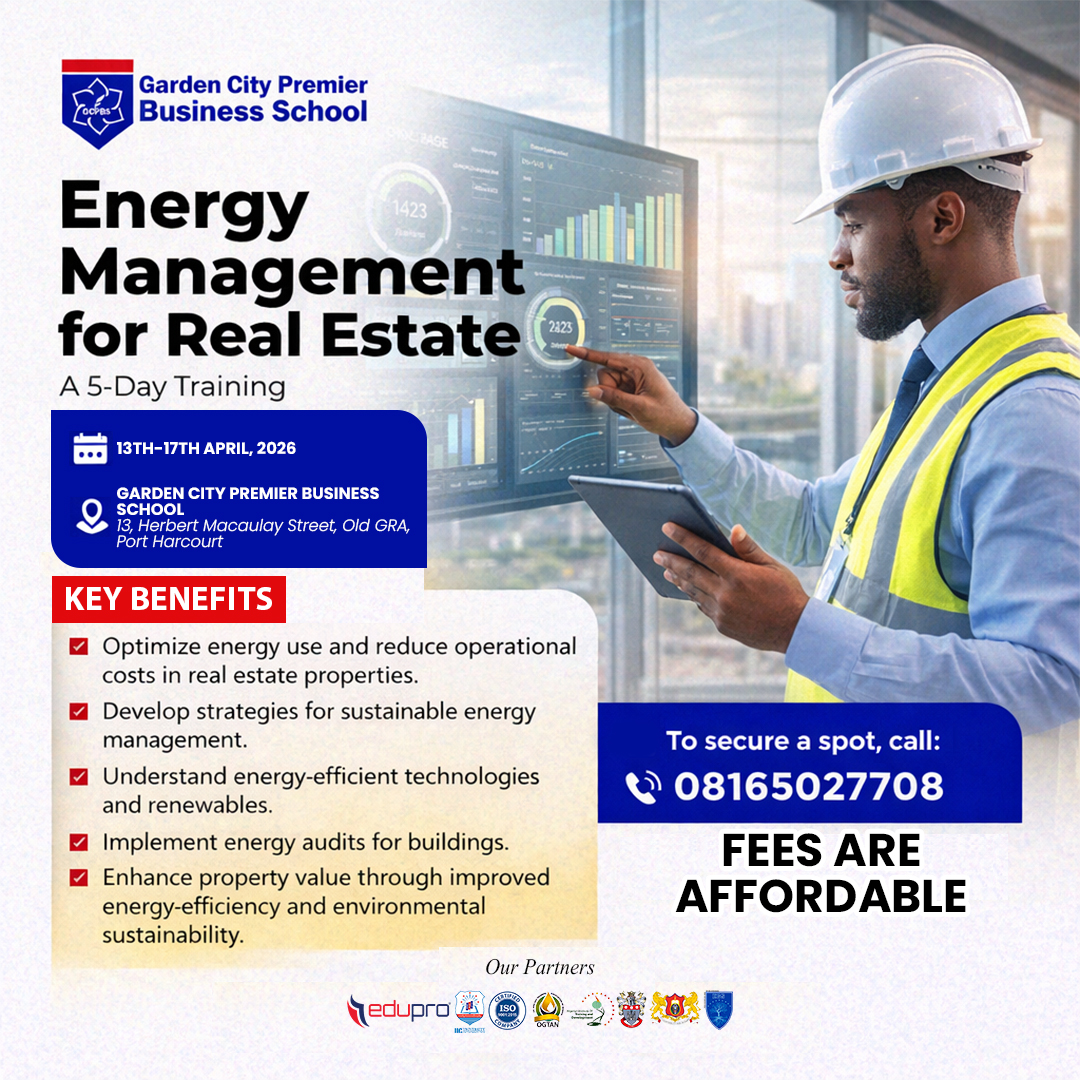
Energy Management for Real Estate
Course Location: Garden City Premier Business School, 13, Herbert Macaulay Street, Old GRA, Port Harcourt.
WEEK TWO
DAY 1: Fundamentals of Energy Management
Introduction
This session introduces the principles of energy management, focusing on consumption patterns, efficiency strategies, and global energy challenges affecting real estate development.
Objectives
- Understand energy management concepts and importance
- Analyze energy consumption patterns in buildings
- Differentiate energy efficiency and conservation
- Identify global and local energy challenges
- Conduct basic energy audits
- Identify energy-saving opportunities
Course Outline
Morning Session:
- Energy management concepts
- Consumption patterns
- Efficiency vs conservation
- Global energy issues
Afternoon Session:
- Energy audit types
- Audit processes and tools
- Identifying savings opportunities
DAY 2: Building Energy Systems & Efficiency Techniques
Introduction
This session explores building systems and technologies that influence energy consumption, focusing on optimizing efficiency in real estate operations.
Objectives
- Understand HVAC systems and energy use
- Analyze lighting and electrical systems
- Evaluate water heating and pumping systems
- Apply energy efficiency technologies
- Use smart meters and automation systems
- Implement demand-side management strategies
Course Outline
Morning Session:
- HVAC systems
- Lighting and electrical systems
- Energy benchmarks
Afternoon Session:
- Efficient appliances
- Insulation and thermal performance
- Smart systems and automation
DAY 3: Renewable Energy Integration
Introduction
This session focuses on integrating renewable energy solutions into real estate projects, enhancing sustainability and reducing operational costs.
Objectives
- Understand renewable energy options (solar, wind, hybrid)
- Conduct feasibility assessments for buildings
- Design solar PV systems
- Understand energy storage solutions
- Compare grid-tied and off-grid systems
- Evaluate cost-benefit of renewable projects
Course Outline
Morning Session:
- Renewable energy options
- Feasibility analysis
Afternoon Session:
- System design and sizing
- Energy storage
- Cost-benefit analysis
DAY 4: Energy Management Strategies & Policies
Introduction
This session highlights strategic planning, policies, and regulatory frameworks guiding energy management and sustainability in real estate.
Objectives
- Develop energy management plans
- Apply ISO 50001 standards
- Set energy performance indicators (EnPIs)
- Monitor and verify energy savings
- Understand building regulations and certifications
- Evaluate sustainability and carbon reduction strategies
Course Outline
Morning Session:
- Energy planning frameworks
- Performance indicators
- Monitoring systems
Afternoon Session:
- Regulations and certifications
- Sustainability practices
- Government policies
DAY 5: Practical Applications & Cost Management
Introduction
The final session focuses on real-world applications of energy management, emphasizing cost control, investment evaluation, and continuous improvement.
Objectives
- Apply best practices in energy-efficient building design
- Conduct energy cost analysis
- Evaluate ROI on energy projects
- Identify financing options
- Implement monitoring and maintenance systems
- Develop continuous improvement strategies
Course Outline
Morning Session:
- Energy-efficient building practices
- Retrofitting strategies
- Risk management
Afternoon Session:
- Cost analysis and budgeting
- ROI evaluation
- Financing and monitoring